Your business teams need training faster than you can produce it.Got 10 minutes?

Fluender turns an internal document into a first version of an interactive e-learning module in about 10 minutes. Your experts review and approve it before it reaches learners.
  • Trusted by Allianz, Mobilize and the French State
  • SCORM 1.2 export, tested with SAP SuccessFactors, Cornerstone and SCORM Cloud
  • Your documents stay yours: stored in France, never used by Fluender to train AI models

Accelerated by
Accelerated by
Supported by

How Fluender works

Upload your documents

Drop your internal procedures, product sheets or compliance directives — PDFs, Word files, PowerPoint files. Fluender analyses them and extracts what matters.

Configure your module

Define your learner profile and your learning objective: memorisation, assessment, or practical scenarios. Fluender builds the module for that audience.

AI builds the module

In about 10 minutes for a 30-page document, Fluender generates a first version of the module — videos, activities, quizzes, flashcards, fill-in-the-blanks, and more. Your experts review and edit it before publishing.

Deploy and track results

Export in SCORM for your LMS or share via QR code. Learners access it on the Fluender Learn app, on web and mobile.

What changes for your training team

≈ 10 min to generate a first version of a module from a 30-page document, before your experts' review
In-house Not outsourced your subject-matter experts produce and approve the training themselves, without an instructional design project
SCORM 1.2 export tested with SAP SuccessFactors, Cornerstone and SCORM Cloud

Generation time observed for a 30-page document. Review and deployment time depend on your organisation.

Trusted by training teams

Internal protocols better understood by field teams

By changing the formats, and the words too, it led, I believe, to a better understanding and a better appropriation of our internal protocols by the team.

François Blanchard - Deputy Operations Director - Vivalto Vie

Ready to transform your training?

See Fluender in action — no commitment required.

Frequently Asked Questions

Find answers to common questions about Fluender, its philosophy, and how it can help your teams.

Philosophy and Accessibility

Can non-experts create e-learning with AI — without any technical knowledge?
Yes, and that is exactly who Fluender is built for. No prompting skills, no instructional design background required. You bring your expertise and your documents; Fluender proposes the structure, the activities and the formatting. You then review and adjust the module before publishing it.
How long does it take to turn a document into a ready-to-deploy e-learning module?
Generating a first version from a 30-page document typically takes around 10 minutes, for a module of 15 to 20 minutes of learning. Your experts then review and adjust it before publishing; how long that takes depends on your own validation process.

Content Creation and Adaptation

How does Fluender personalise training for each learner profile?
Inside Fluender, you define learner profiles for your organisation: job role, experience level, language, available time. When you create a module, you pick the target profile and the AI automatically calibrates vocabulary, information density, and pacing. The same source document can produce distinct modules for a junior hire and a senior manager.
What file formats does Fluender accept to generate training?
Fluender accepts the most common business formats: PowerPoint (PPTX), Word (DOCX), PDF, and more. The AI extracts key concepts from these sources and transforms them into structured learning paths — without any copy-pasting or manual reformatting.
Does Fluender just summarise documents, or does it actually build pedagogy?
It builds pedagogy. Fluender performs a structured analysis of your content to identify core concepts, then constructs a full learning scenario with clear objectives (understand, apply, evaluate) and varied activities — quizzes, scenarios, key takeaways. The output is a module, not a summary.

Editing and Media

Can I edit a module after Fluender has generated it?
Yes, full control is always yours. Fluender includes a built-in LCMS editor — as intuitive as a presentation tool — where you can rewrite text, reorder sequences, or add your own content on top of what the AI produced.
How does Fluender handle visuals and illustrations?
Fluender automatically extracts diagrams and visuals from your source documents. Where illustrations are missing, the platform generates contextual images using generative AI to keep modules visually engaging — no graphic design work required.

Distribution and Technical Integration

Are Fluender modules compatible with my LMS?
Yes. Fluender exports in SCORM format, the universal standard supported by all major LMS platforms — SAP SuccessFactors, Cornerstone, Moodle, and others. If you already have a learning infrastructure, your modules slot right in.
We don't have an LMS. How do we distribute training to our teams?
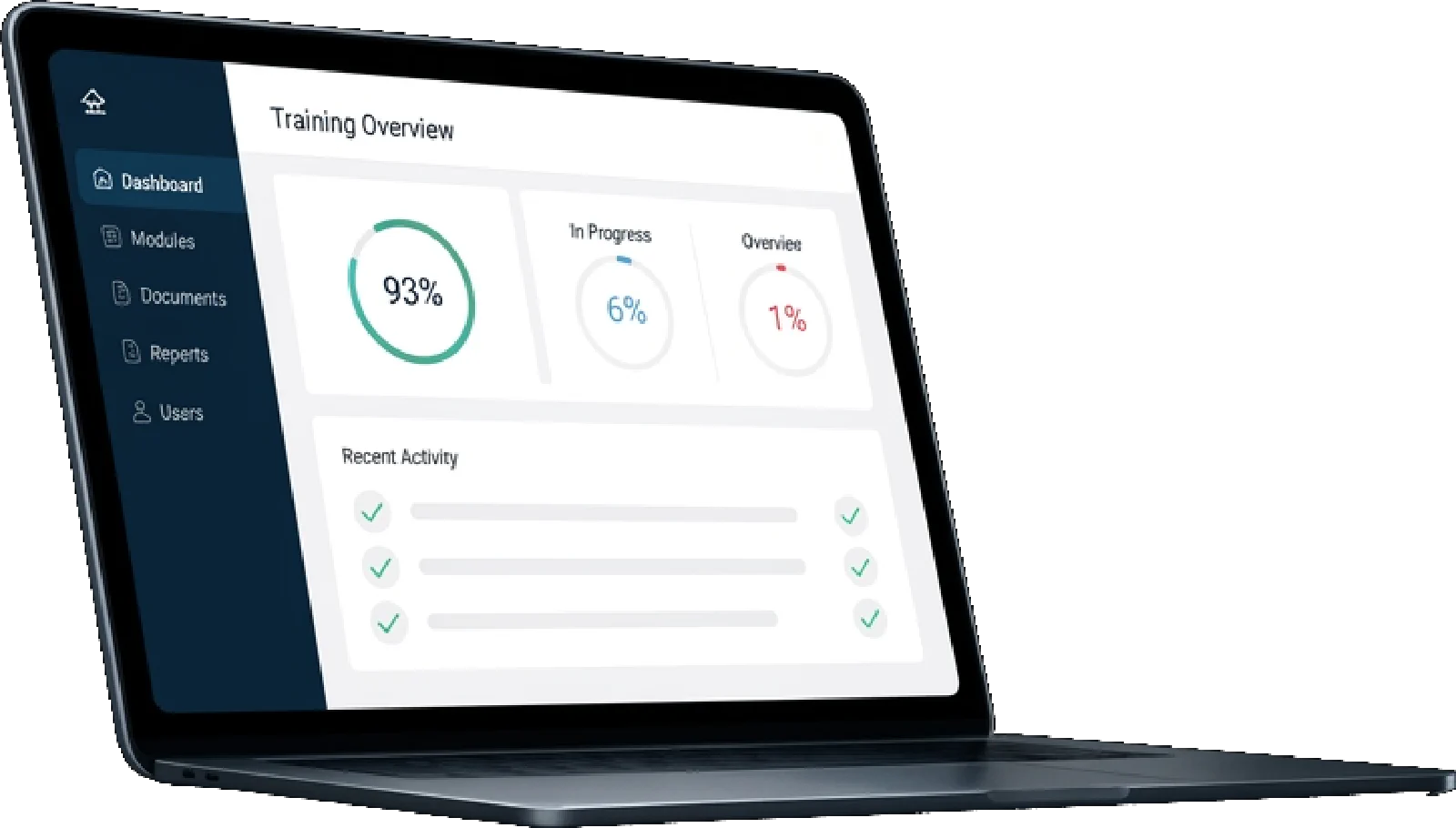
Fluender includes its own learning space: you can publish modules, manage learner access, track completion and invite learners by email or QR code, without an external platform.
What happens when our source documentation changes — a new regulation, a product update?
Upload the updated document and generate a new version of the module, then have your experts review it before republishing.
What does Fluender cost?
Pricing is volume-based and decreases as your usage grows. Fluender offers two billing models: per SCORM export — for organisations that already have an LMS — or per active learner, when distributing through our built-in platform. Contact us for a quote tailored to your setup.
We have existing training content on another platform. Can we import it?
Fluender can import content in SCORM format as well as PDF documents. For a migration from another platform, our team assesses feasibility case by case. Get in touch.

AI Regulation & Ethics

Will Fluender ever use my company's data to train its AI?
No. Fluender does not use the documents you upload or the content generated on the platform to train, fine-tune or otherwise improve any AI model.
Which AI models does Fluender use, and where are they hosted?
Fluender uses different AI models depending on the task. Source documents and generated modules are stored in France. Document analysis and pedagogical scripting can run with a European provider in Zero Data Retention mode. Voice and video generation use external models, which may process data outside the European Union. Which providers are involved depends on the models and media features selected; we can review them with your security team before you upload sensitive content.
Can Fluender be hosted on our own servers?
For organisations with strict infrastructure requirements, a dedicated deployment — dedicated server, on-premise installation, or connection to your own AI infrastructure — can be studied. Tell us about your requirements.
How does Fluender approach the EU AI Act?
Fluender is a content creation tool: it generates training material that your experts review, and it takes no decisions about people. Your own classification under the AI Act also depends on how you use the content; we can go through it with your compliance team.
When do EU AI Act obligations apply?
The EU AI Act entered into force on 1 August 2024 and its obligations apply in stages. The European Union has been amending the timetable for high-risk systems: refer to the texts published in the Official Journal of the European Union for the dates in force.

Data Privacy & Security

Where is our data stored, and does any of it leave France or the EU?
Source documents and generated modules are stored in France. Document analysis can be kept within the EU with a European provider in Zero Data Retention mode. AI voice and video generation use external models that may process data outside the EU; which providers are involved depends on the features you enable, and we can review them with your security team.
How does Fluender handle GDPR?
When your teams use the platform, Fluender processes their data on your behalf, under a data processing agreement signed with each customer. That agreement lists the processors involved, including the AI providers used by the features you enable. The website’s own processing is described in our Privacy Policy.